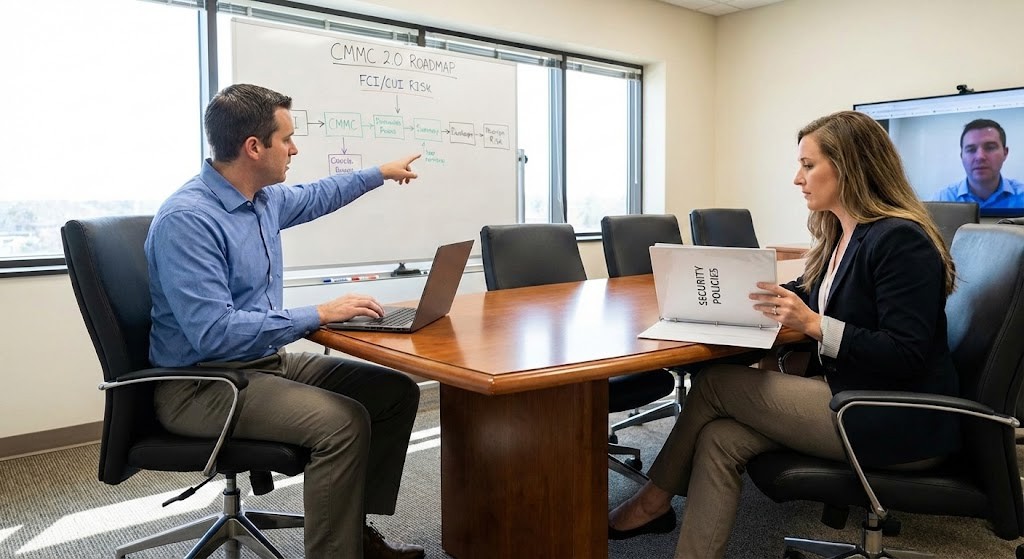
No CISO, No Problem: How IT Leaders Can Wear the CISO Hat for CMMC 2.0
Many small and midsize defense contractors will never hire a full-time Chief Information Security Officer, but CMMC 2.0 still expects them to behave like mature, well-governed security organizations. This means IT directors and CFOs often end up “playing CISO” whether they planned to or not, steering both security decisions and CMMC compliance.
Why a CISO Mindset Still Matters
CMMC 2.0 is designed to protect federal contract information (FCI) and controlled unclassified information (CUI) across the entire defense industrial base, not just in large enterprises with formal security teams. Even without a CISO on the org chart, someone still has to own security strategy, risk decisions, and accountability to the DoD and prime contractors.
For small and medium businesses, this “someone” is usually:
- The IT director or managed service provider guiding technical controls and day‑to‑day operations.
- The CFO or operations lead, who controls budgets, risk tolerance, and contract obligations tied to CMMC.
What “Playing CISO” Really Means
A true CISO role combines three things: setting security strategy, managing risk, and communicating clearly with executives and the board. When IT leaders or CFOs wear the CISO hat, they do not need a new title, but they do need to intentionally own those three responsibilities for CMMC 2.0.
In practice, that means:
-
Defining a security roadmap aligned to CMMC level and contract requirements, not just buying tools.
-
Maintaining a living picture of cyber risk, including vendors, cloud services, and legacy systems.
-
Translating technical gaps into business impact so leadership can prioritize funding and staffing.
CMMC 2.0 Priorities for Accidental CISOs
CMMC 2.0 focuses heavily on core hygiene: access control, incident response, configuration management, logging, and continuous improvement. The acting CISO’s job is to keep everyone aligned on a small set of “must win” priorities instead of chasing every possible security project at once.
High‑impact priorities for IT leaders wearing the CISO hat include:
-
Getting scoping right: clearly defining what systems store or process FCI/CUI, and limiting that footprint.
-
Closing obvious control gaps: MFA everywhere, strong backups, patching, endpoint protection, and basic logging.
-
Building minimal but real governance: written policies, repeatable procedures, training, and evidence collection for assessors.
How IT and Finance Share the CISO Hat
CMMC 2.0 success in smaller organizations comes from tight collaboration between the people who understand the technology and the people who control the money and risk posture. IT leaders can map CMMC requirements to specific projects, while CFOs decide how quickly to close gaps and how much residual risk is acceptable.
A practical division of labor often looks like:
-
IT: owns control implementation, vendor coordination, monitoring, and incident response playbooks.
-
Finance/operations: owns contract language, insurance, budget, and tracking CMMC status in overall business risk reporting.
When to Bring in Outside Help
Because CMMC 2.0 is nuanced and evolving, many SMBs augment their in‑house “CISO by necessity” with external expertise such as a virtual CISO (vCISO) or specialized CMMC consultants. These partners can help interpret requirements, prioritize remediation, and prepare for assessments, while the internal IT and finance leaders still retain ultimate accountability.
This model lets IT leaders and CFOs keep the CISO hat for strategy and decision‑making, while offloading some of the heavy lifting around frameworks, documentation, and readiness reviews. For most small and medium defense contractors, that blend of internal ownership and targeted outside help is the most realistic path to sustainable CMMC 2.0 compliance.